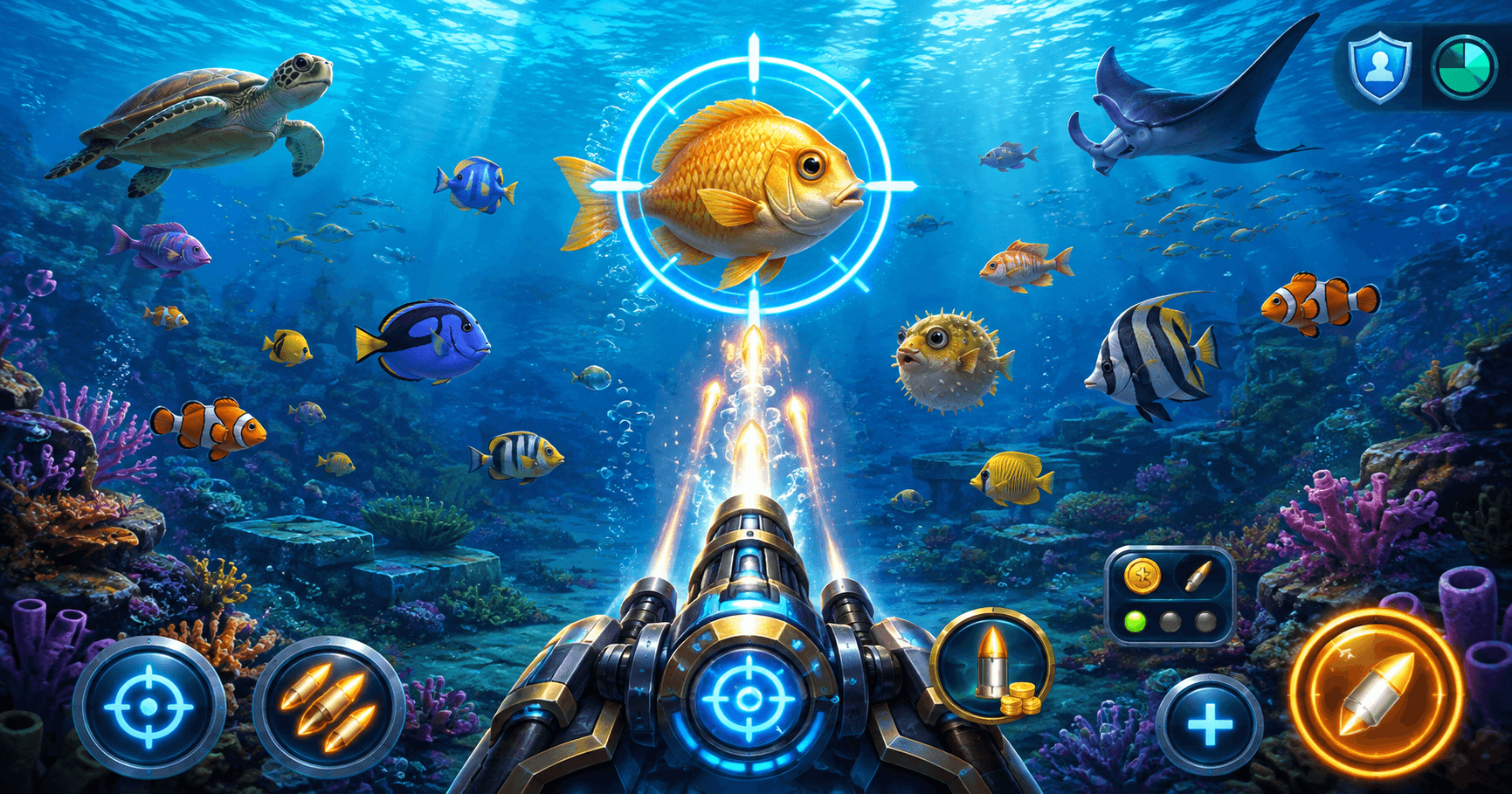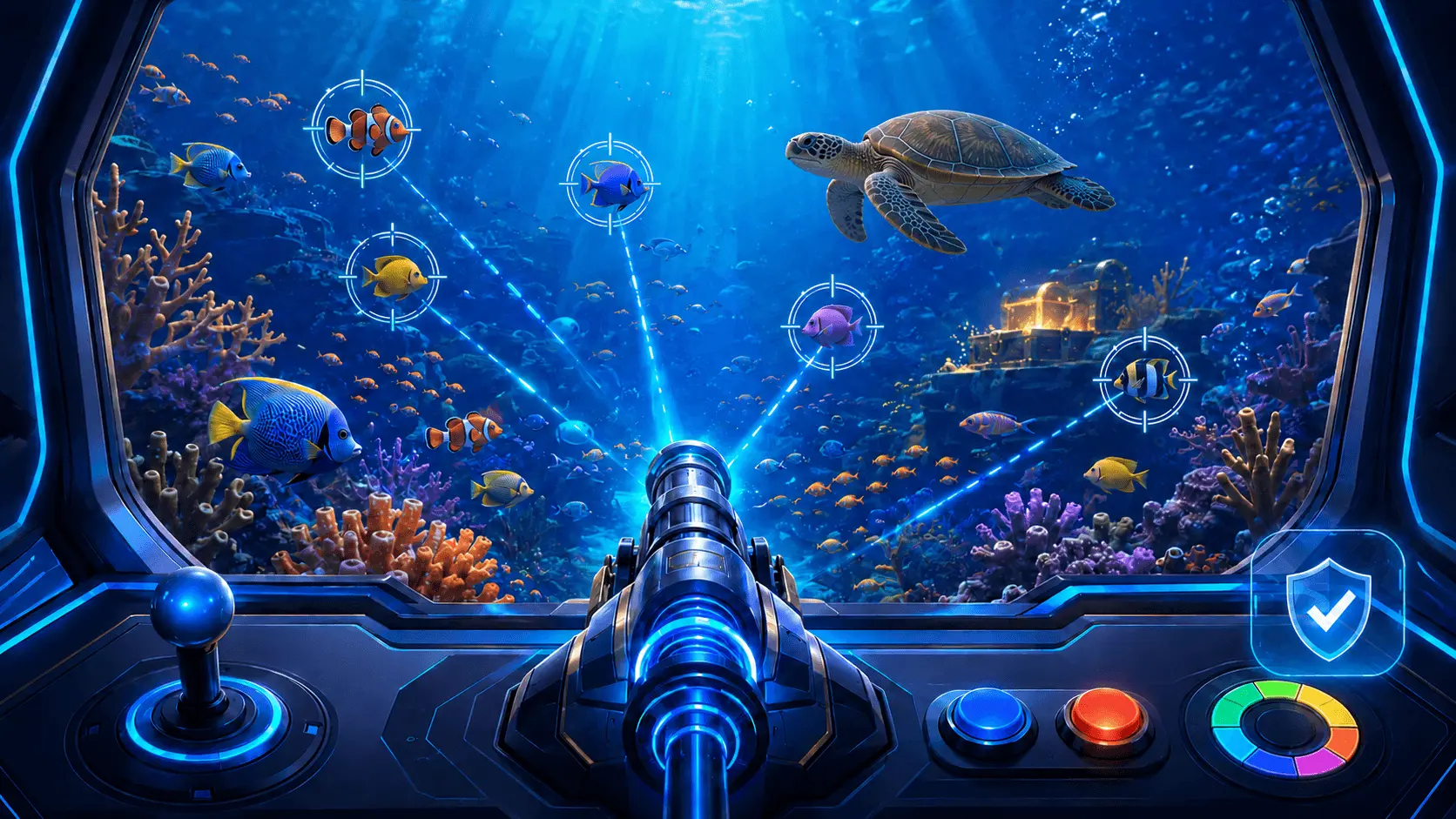
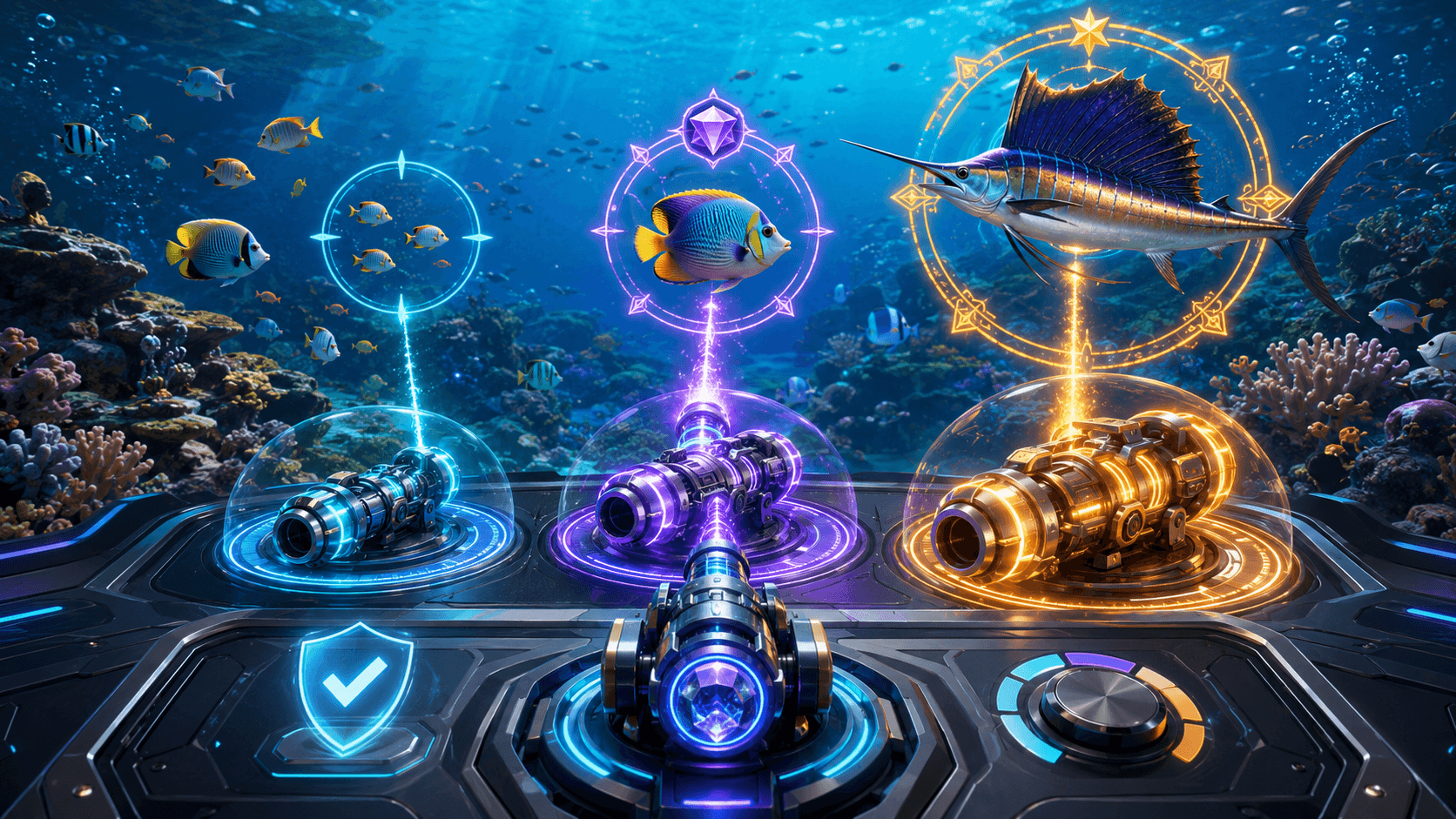
Fishing game cannon levels control how much game credit may be used each time a cannon or weapon is activated. Target values indicate the possible value, multiplier or feature associated with a qualifying target result.
These two settings are often connected, but they should not be confused. The cannon level normally relates to the cost of an action, while the target value describes how a qualifying result may be calculated.
A higher cannon setting may increase both the cost and the possible resulting value under some game models. It does not guarantee that the next target will produce a return.
This guide explains cannon levels, firing costs, target multipliers, automatic controls and special weapons. Visit the Play88 Online Fishing Games Malaysia page to review current titles, themes and provider information.
What Is a Fishing Game Cannon Level?
A cannon level is the current setting applied to a standard cannon, themed weapon or firing action. Depending on the title, the level may be displayed as:
- A credit value.
- A coin value.
- A numerical level.
- A multiplier.
- A weapon tier.
- A plus or minus control.
The displayed setting may determine how much game credit is used when the firing control is activated. For example, a cannon showing 5 units may use 5 units for each action.
Some games allow the level to be changed at any time. Others may restrict adjustments during special events, automatic firing or particular game-room conditions.
How Does Cost per Action Work?
The cost per action is the amount applied each time the cannon or weapon is activated. One click or tap may count as one action, but automatic and special-weapon controls can work differently.
Before firing, identify:
- The current cannon setting.
- The cost of one action.
- Whether the cost changes during special features.
- Whether auto-fire is currently enabled.
- Whether a special weapon uses a separate value.
| Example cost per action | 10 actions | 25 actions | 50 actions |
|---|---|---|---|
| 1 unit | 10 units | 25 units | 50 units |
| 2 units | 20 units | 50 units | 100 units |
| 5 units | 50 units | 125 units | 250 units |
| 10 units | 100 units | 250 units | 500 units |
These examples show how repeated actions can accumulate. They do not include any possible target results and do not represent recommended settings.
Why Small Changes Can Matter
Changing from a 2-unit cannon to a 5-unit cannon may appear to be a small interface adjustment. However, over 50 actions, the total action cost increases from 100 units to 250 units.
This difference becomes more significant when:
- Auto-fire is enabled.
- The game uses a rapid firing speed.
- Several targets are selected in succession.
- A feature event encourages repeated actions.
- The session continues for an extended period.
Common Cannon-Level Formats
Providers may display cannon settings differently. Read the game information to determine what the number beside the weapon actually represents.
| Cannon format | General presentation | Information to check |
|---|---|---|
| Credit value | A number shows the cost of each action | Whether one activation always uses that amount |
| Multiplier level | The cannon displays 1×, 2×, 5× or another multiplier | The base value being multiplied |
| Numerical level | The weapon is labelled Level 1, Level 2 or higher | How each level changes cost and resulting values |
| Weapon tier | Different cannons or weapons represent different settings | Cost, firing pattern and target coverage |
| Temporary enhancement | A feature increases the cannon level for a limited period | Feature duration and whether the action cost changes |
| Room-based setting | Available cannon levels depend on the selected game room | Room minimums, maximums and entry requirements |
Credit-Based Cannons
A credit-based cannon directly displays the amount used for one firing action. Plus and minus buttons may increase or reduce the value.
Multiplier-Based Cannons
A multiplier-based cannon may display the current setting relative to a base unit. For example, a 5× cannon could represent five times the game’s base action cost.
Do not assume that the multiplier refers to the target value. It may refer only to the cannon’s action cost.
Weapon Tiers
Some games replace numerical cannon levels with visually different weapons. A larger or more elaborate weapon may have a different cost, firing pattern or coverage area.
The visual design alone does not explain whether the weapon changes result probability. Review its published description.
What Is a Fishing Game Target Value?
A target value describes the possible credit value, multiplier or feature connected to a qualifying result involving that target.
It may be shown:
- Beside the target.
- In a target-information menu.
- As a value range.
- As a multiplier.
- Through a special icon.
- Only after the target produces a result.
A target value should not be interpreted as a guarantee. The target must first meet the provider’s qualifying conditions.
Common Target-Value Formats
| Target-value format | General meaning | What to check |
|---|---|---|
| Fixed multiplier | The target displays one stated multiplier | Which cannon or action value is multiplied |
| Multiplier range | The target displays a minimum and maximum value | How the value within the range is determined |
| Fixed credit value | The target displays a stated credit amount | Whether cannon level affects the credited value |
| Feature symbol | The target may activate a special weapon or event | Trigger conditions and feature duration |
| Progress value | The target contributes toward a feature or meter | Required progress and reset conditions |
| Boss value | A larger target uses special or variable settlement | Timer, qualifying conditions and multiplayer rules |
| Hidden value | The final value is revealed only after qualification | Possible range and calculation method |
Fixed Target Multiplier
A target labelled 5× may produce a value based on five times the applicable cannon or action amount if the target result qualifies.
Check whether the original action cost is included in or separate from the credited value.
Target-Value Range
A target may display a range such as 5×–20×. This indicates that different qualifying values may be possible.
The highest number in the range is not guaranteed. Read how the title determines which value applies.
Feature Target
A feature target may activate a laser, bomb, freeze effect or additional round instead of producing a simple multiplier result.
Review whether the feature:
- Provides a fixed value.
- Affects several targets.
- Uses a separate weapon.
- Continues for a limited period.
- Changes the cannon cost.
How May Cannon Levels and Target Values Be Calculated?
Some fishing games use a direct multiplication model. Under this type of model, the current cannon amount is multiplied by the qualifying target value.
The general illustrative calculation is:
Possible credited value = cannon amount × qualifying target multiplier
| Example cannon amount | Example target multiplier | Illustrative credited value |
|---|---|---|
| 1 unit | 5× | 5 units |
| 2 units | 5× | 10 units |
| 5 units | 5× | 25 units |
| 5 units | 10× | 50 units |
| 10 units | 20× | 200 units |
These calculations are examples only. Not every fishing game uses direct multiplication, and the table does not indicate how likely a target is to qualify.
Possible Alternative Calculation Models
A title may instead use:
- A fixed value unrelated to the cannon level.
- A value selected from a published range.
- A feature-based calculation.
- A shared multiplayer settlement.
- A progressive or accumulated feature value.
- Another provider-specific mathematical model.
Use the in-game paytable and help information rather than applying a formula from another fishing game.
Does a Higher Cannon Level Improve the Result?
A higher cannon level does not guarantee that the next target will qualify. It may increase the cost of the action and, under some game models, scale the possible credited value.
The provider’s rules should explain whether the cannon setting affects:
- Action cost only.
- Possible target value.
- Weapon appearance.
- Firing coverage.
- Feature eligibility.
- Room access.
Do not assume that increasing the cannon level makes a target “due” or ensures that previous action costs will be recovered.
Changing Levels After Unsuccessful Attempts
Several unsuccessful actions do not guarantee that a higher cannon level will produce a different result. Increasing the setting at that point only confirms that subsequent actions will use more credit if the cost scales with the level.
Do Target Size and Movement Affect Target Values?
Fishing-game targets may differ visually by size, speed and movement pattern. These characteristics can affect how the participant uses the aiming interface, but they do not by themselves explain the target’s mathematical rules.
| Target characteristic | Possible interface effect | What should not be assumed |
|---|---|---|
| Large target | May be easier to see and select | That it guarantees a successful result |
| Small target | May occupy less screen space | That it always has a low value |
| Slow movement | May be easier to follow manually | That the target is more likely to qualify |
| Fast movement | May require quicker aiming | That the target always has a higher value |
| Boss appearance | May indicate a feature or special rule | That a large value is guaranteed |
| Target near the cannon | May require less aiming movement | That distance determines the outcome |
Check the target table or provider information instead of relying on visual assumptions.
How Do Auto-Fire and Lock-On Affect Cannon Costs?
Auto-Fire
Auto-fire repeatedly activates the cannon at the current setting. If the cannon level changes while auto-fire remains active, subsequent actions may use the new amount.
Before enabling it, confirm:
- The current cannon level.
- The frequency of firing.
- The selected target or direction.
- Whether it continues after the target leaves.
- How it is paused or stopped.
Lock-On
Lock-on keeps the cannon aimed at a selected target. It may be used together with manual or automatic firing.
Lock-on affects targeting convenience. It does not guarantee that the selected target will qualify or that repeated actions will recover their cost.
| Control setting | Action behaviour | Main cost concern |
|---|---|---|
| Manual aim and fire | Each action is activated individually | Repeated clicks can still accumulate quickly |
| Lock-on with manual fire | The cannon follows one target while actions remain manual | Repeated targeting may continue longer than planned |
| Manual aim with auto-fire | Actions repeat in the selected direction | Credits continue to be used automatically |
| Lock-on with auto-fire | The cannon follows one target and fires repeatedly | Repeated costs can accumulate until the control is stopped |
| Rapid-fire feature | Actions occur faster for a stated period | Higher action frequency can increase total cost |
Special Weapons and Cannon Settings
Special weapons may use different cost and value rules from the standard cannon. Examples can include lasers, bombs, nets, chain effects or screen-wide attacks.
A special weapon may be:
- Received from a qualifying target.
- Activated during a feature event.
- Available for a limited period.
- Linked to the current cannon value.
- Assigned a separate fixed value.
- Restricted to certain targets.
Before activating a special weapon, check whether:
- It uses additional credit.
- The cannon level remains adjustable.
- The weapon applies the current cannon multiplier.
- Every affected target is evaluated separately.
- A maximum resulting value applies.
A large visual effect does not guarantee that every target shown on screen will qualify.
Cannon Levels in Multiplayer Fishing Games
In a multiplayer room, several participants may use different cannon levels while targeting the same creature or feature.
The provider’s rules determine:
- How a qualifying result is assigned.
- Whether action history is shared or individual.
- Whether several participants can receive a value.
- How boss or feature targets are settled.
- Whether the final action has any special importance.
Do not assume that another participant’s repeated actions weaken a target or make it more likely to qualify. Unless the provider describes a shared health or progress system, this should not be treated as a game rule.
What Should You Check Before Changing Cannon Level?
| Setting or information | Question to check |
|---|---|
| Current cannon amount | How much does one action currently use? |
| Available levels | What are the minimum and maximum cannon settings? |
| Target calculation | Does the game multiply the target value by the cannon amount? |
| Automatic controls | Is auto-fire or lock-on currently active? |
| Firing speed | How quickly can repeated actions accumulate? |
| Special weapons | Do feature weapons use the current cannon value? |
| Target-value range | Is the displayed number fixed, variable or feature-based? |
| Multiplayer rules | How are shared targets and boss results assigned? |
| Session limit | Does the setting fit within the predetermined budget? |
| Provider help | Where is the complete calculation and settlement information? |
Common Cannon-Level and Target-Value Mistakes
Assuming a Higher Level Guarantees Success
A higher cannon level may increase action costs and possible values, but it cannot guarantee a qualifying target result.
Confusing Cannon Multiplier With Target Multiplier
The cannon setting and target value can represent different parts of the calculation. Check which amount is being multiplied.
Focusing Only on the Maximum Target Value
A maximum target value may be only one possible result within a range. It does not indicate how frequently that value occurs.
Changing the Cannon While Auto-Fire Is Active
If automatic firing continues after the level changes, repeated actions may use more credit than expected.
Assuming a Boss Target Guarantees a Large Value
Boss targets may use special rules, variable values or feature conditions. Their appearance alone does not guarantee a result.
Following Another Participant’s Cannon Level
Another participant’s setting does not show which level is appropriate or predict how a target will be settled.
Believing Repeated Actions Make a Target Due
Previous unsuccessful actions do not guarantee that the target will qualify next.
Ignoring Total Repeated-Action Costs
The cost of one action may appear small, but manual or automatic firing can cause the total to accumulate quickly.
Practical Safer-Play Guidelines
Fishing-game cannon settings involve financial risk. A higher level, special weapon or valuable-looking target cannot guarantee a successful result.
- Set a fixed spending limit before entering a game room.
- Use only money not required for essential expenses.
- Confirm the cost of one action before firing.
- Choose a cannon level that fits the predetermined budget.
- Check whether auto-fire is active.
- Set a session time limit and take regular breaks.
- Do not increase the level to recover previous losses.
- Avoid treating a boss or feature target as guaranteed value.
- Use available deposit limits, cooling-off periods or self-exclusion tools when needed.
Stop participating if it becomes difficult to follow a spending or time limit. Visit the Play88 FAQ page for general account, support and responsible-gaming information.
Frequently Asked Questions About Cannon Levels and Target Values
What does a fishing game cannon level mean?
It is the current setting applied to the cannon or weapon. Depending on the game, it may determine the cost of each action and how qualifying target values are calculated.
Does a higher cannon level guarantee a successful result?
No. A higher level may increase the action cost and possible resulting value, but it cannot guarantee that the target will qualify.
What does a 10× target value mean?
It may mean that a qualifying target result is calculated using ten times an applicable amount. Check whether that amount is the cannon value, base credit or another figure.
Is the original cannon cost included in the target value?
This depends on the provider’s calculation. Review whether the displayed value includes or excludes the original action cost.
Does a larger target have a better chance of producing a result?
Visual size alone does not explain or guarantee the target’s mathematical behaviour.
Does lock-on improve the target result?
Lock-on changes how the cannon follows a target. It does not guarantee a qualifying result.
Can auto-fire use a higher cannon level automatically?
If the level is changed while auto-fire remains active, subsequent actions may use the new amount. Check the game controls.
Do special weapons use the current cannon level?
Some may use the current level, while others apply fixed or feature-specific values. Review the special-weapon rules.
Do previous actions weaken a target?
This should not be assumed unless the provider explicitly describes a health or progress system.
Can a cannon-level strategy guarantee a profit?
No. No cannon progression, target pattern or automatic-control setting can guarantee a profitable result.
Check the Cannon Cost and Target Calculation First
Cannon levels and target values become easier to understand once the cost per action and calculation method are clear. Before changing the setting, review the current cannon amount, automatic controls, target-value format and provider rules.
Explore current titles and provider information through the Play88 Online Fishing Games Malaysia page. Cannon levels, target calculations, features, providers and availability may vary by game, account and location.
This article provides general information and does not guarantee any result. Participate only where permitted by applicable law, meet all applicable age requirements and play responsibly.