
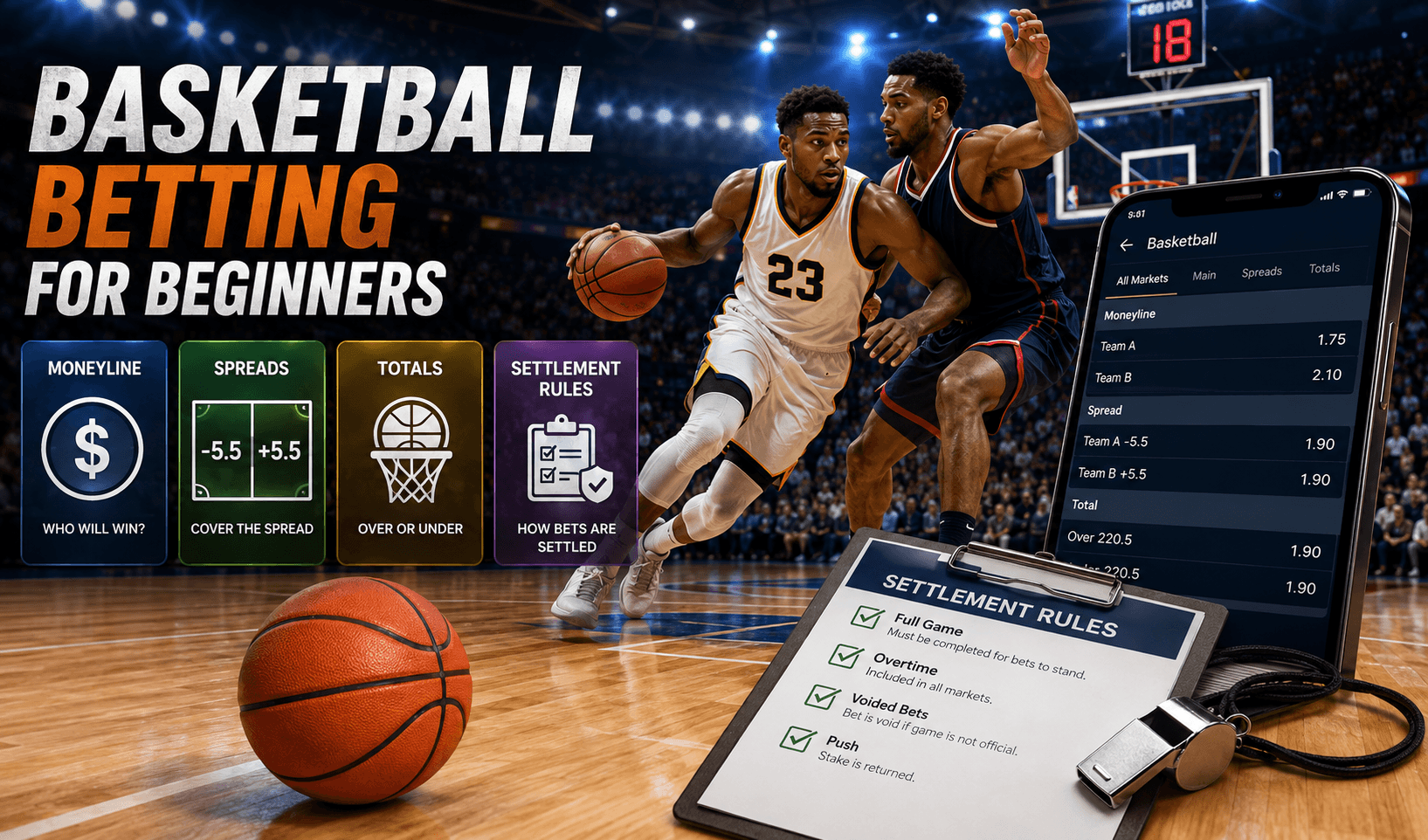
Basketball betting shares some market types with football, including handicaps and totals, but the scoring scale and settlement conventions are different. A basketball game is divided into periods, a standard full-game winner market normally has no draw, and overtime is commonly included in full-game settlement unless the market says otherwise.
Those details make the complete market title important. “First quarter,” “first half,” “regulation only” and “full game” can refer to different score periods, while a whole-number spread or total can produce a push that a half-point line cannot.
This Play88 guide explains basketball moneyline, point spreads, Over and Under totals, quarter and half markets, overtime rules, player props and other common settlement conditions. Read Sports and E-Sports Betting for Beginners for a broader introduction to odds, market names and selection checks. Current NBA fixtures and provider information are available on the Play88 Sports Betting and E-Sports Malaysia page.
Fixtures, odds, lines, market availability and rules can change before or during a game. Review the specific provider’s terms, set time and spending limits, and participate only when legally eligible in your location. No team, player, price or statistical trend guarantees a result.
How Do Basketball Betting Markets Work?
A basketball fixture can offer markets covering the full game, a particular quarter or half, one team’s score, or an individual player’s statistics. Each market states what must happen and which period of the game counts toward settlement.
One NBA fixture may offer selections involving:
- Which team wins the game outright through a moneyline market.
- A virtual points adjustment applied through a point spread.
- Whether the combined score finishes Over or Under a published total.
- The result, spread or total for a particular quarter or half.
- A named player’s points, rebounds, assists or other statistics.
- Winning margins, team totals, race-to-points markets or other game events.
Before confirming a basketball selection, check:
- The teams, league and scheduled start time.
- The complete market name, including the game period.
- The selected team, player or outcome.
- The spread or total line and whether it contains a whole or half point.
- The current decimal odds.
- Whether overtime is included.
- The provider’s rules for postponements, player participation and interrupted games.
- The accepted selection, line and odds shown in the confirmation.
Moneyline, spread and total markets describe different conditions. A team can win the game while failing to cover a negative spread, and a winning moneyline selection does not determine whether the combined total finishes Over or Under.
Understanding Basketball Game Periods
An NBA game has four 12-minute regulation periods. If the score is tied after the fourth quarter, five-minute overtime periods are played until a winner is determined. Other leagues can use different period lengths or formats, so the competition and market rules should always be checked.
| Market period | General coverage | Important detail to check |
|---|---|---|
| First quarter | The score during the opening quarter only | Completion requirements and tie or push treatment |
| First half | The first and second quarters combined | That the market is separate from the full-game result |
| Second half or fourth quarter | The named later period | Whether a provider includes any subsequent overtime |
| Full game | All four regulation quarters | Whether overtime is included or the market says “regulation only” |
| Overtime-specific | Only the stated overtime period or event | The qualifying overtime period and void conditions |
Do not infer the period from an abbreviated team name or price. Read the full market heading. A first-half spread, a second-half spread and a full-game spread can show different lines and are settled independently.
The treatment of extra periods also differs by sport. Standard basketball full-game markets commonly include overtime, whereas many football markets are based on regulation time unless extra time is expressly included. The Football Betting for Beginners guide explains that separate convention.
What Does Moneyline Mean in Basketball?
A moneyline market is a selection on which team wins without a virtual points adjustment. In a standard two-way full-game market, the selected team must lead after the score period used for settlement, commonly including overtime.
| Market | Selection condition | Settlement detail |
|---|---|---|
| Full-game moneyline | Select the team to win the game outright. | Overtime commonly counts unless otherwise stated. |
| Regulation-time winner | Select the team to lead at the end of regulation. | A draw or tie option may be offered because overtime is excluded. |
| Quarter or half winner | Select the team to lead at the end of the named period. | Tie treatment depends on whether the market is two-way or three-way. |
For example, if Team A and Team B are tied after four quarters and Team A wins in overtime, a standard full-game Team A moneyline selection commonly succeeds. A regulation-time Team A selection would not, because Team A was not ahead when regulation ended. The exact market title and provider rules control.
Decimal odds show the potential gross return rather than the probability of a guaranteed outcome:
Illustrative gross return = accepted stake × decimal odds
At decimal odds of 1.80, an illustrative MYR 10 accepted selection would have a gross return of MYR 18 if successful, consisting of MYR 8 profit plus the MYR 10 stake. This arithmetic explains the displayed price; it is not a prediction or recommendation.
How Do Basketball Point Spreads Work?
A point spread applies a virtual points adjustment for market settlement. It does not alter the official score. A negative spread is subtracted from the selected team’s score, while a positive spread is added.
Negative Spread
A favourite listed at −5.5 must win by six or more points for that spread selection to succeed. Merely winning the game is not enough if the margin is smaller than the spread.
Positive Spread
An underdog listed at +5.5 can win outright or lose by five or fewer points for that spread selection to succeed. A six-point loss would not cover +5.5.
| Spread selection | Full-win condition | Push condition |
|---|---|---|
| Team A −5.5 | Team A wins by 6 or more points. | No push is possible because the line contains a half point. |
| Team A −6.0 | Team A wins by 7 or more points. | An exact 6-point Team A win is a push. |
| Team B +5.5 | Team B wins outright or loses by 5 or fewer points. | No push is possible because the line contains a half point. |
| Team B +6.0 | Team B wins outright or loses by 5 or fewer points. | An exact 6-point Team B loss is a push. |
A push means the adjusted score lands exactly on a whole-number line. A straight selection is commonly returned, but accumulator or parlay treatment can be different. Confirm the provider’s settlement rules rather than assuming how a push affects a combined bet.
For a worked example, suppose Team A defeats Team B 110–105:
- Team A −4.5 succeeds because Team A won by five points.
- Team A −5.0 pushes because the winning margin equals the line.
- Team A −5.5 does not succeed because Team A did not win by six or more.
- Team B +5.0 pushes because the five-point addition makes the adjusted scores level.
- Team B +5.5 succeeds because the positive adjustment covers the five-point loss.
How Do Over and Under Basketball Totals Work?
A game-total market compares the combined score of both teams with a published line. An Over selection requires the total to finish above the line, while an Under selection requires it to finish below. Team-total markets apply the same idea to one named team only.
| Published line | Over succeeds when | Under succeeds when | Push condition |
|---|---|---|---|
| 215.5 | The combined score is 216 or more. | The combined score is 215 or fewer. | No push is possible. |
| 216.0 | The combined score is 217 or more. | The combined score is 215 or fewer. | An exact combined score of 216 is a push. |
If the final applicable score is Team A 112 and Team B 104, the combined total is 216. Over 215.5 succeeds, Under 215.5 does not succeed, and either side of a 216.0 two-way total is commonly a push.
Basketball can also offer first-quarter totals, first-half totals, second-half totals, team totals and player-stat totals. These are separate markets. Always confirm both the number and the subject of the line: “Over 108.5 Team A points” is not the same as “Over 218.5 total game points.”
How Do Quarter and Half Markets Work?
Period markets use only the score recorded during the named quarter or half. They are settled independently of the final game result, so a team can cover a first-quarter spread and later lose the full game.
| Market | General coverage | Important detail to check |
|---|---|---|
| First-quarter moneyline | Which team leads after the first quarter | Whether a tie is a push or a separately selectable outcome |
| First-quarter spread or total | The adjusted score or combined points in the first quarter | The quarter-specific line and completion rule |
| First-half moneyline, spread or total | The score across the first two quarters | That the selection does not carry into the second half |
| Second-half market | The score recorded during the stated second-half period | Whether overtime is included by that provider |
| Fourth-quarter market | The score during the stated fourth-quarter market | Whether later overtime is excluded or included under the rules |
First-quarter and first-half markets settle before overtime can occur. Second-half and fourth-quarter overtime treatment is more provider-specific: some rules include subsequent overtime in those markets, while others settle only the named regulation period. Read the market wording and the applicable house rules before confirming a selection.
How Does Overtime Affect Basketball Markets?
If regulation ends level in an NBA game, one or more five-minute overtime periods are played until one team wins. Standard full-game markets commonly use the score after overtime, but “regulation only” and period-specific markets can follow a different rule.
| Market | Common treatment | Required check |
|---|---|---|
| Full-game moneyline | Overtime commonly counts toward the final winner. | Check for “regulation only” or a three-way format. |
| Full-game spread | Overtime points commonly count in the settlement score. | Confirm the market scope and provider rules. |
| Full-game total | Overtime points commonly count toward the combined score. | Confirm that the market is not regulation-only. |
| First-quarter or first-half market | Settled from the completed named period before overtime. | Check completion and abandoned-game rules. |
| Second-half or fourth-quarter market | Overtime treatment can vary by provider. | Read the specific rule rather than inferring from the label. |
| Regulation-only market | Overtime is excluded. | Check how a regulation tie is settled. |
Example: a game is tied 100–100 after regulation and finishes 112–108 after overtime. A standard full-game total commonly uses 220 points, while a regulation-only total uses 200. Those scores can settle the same line differently.
Because provider rules override general conventions, never rely on the word “basketball” alone to infer overtime treatment. Check the complete title, the market information and the rules available at confirmation.
What Are Player Props in Basketball Betting?
A player prop is based on an individual player’s recorded statistics rather than solely on the team result. Common examples use points, rebounds, assists or combined statistical totals.
| Player prop | General qualifying condition | Important detail to check |
|---|---|---|
| Points | The player’s points finish above or below a line. | Participation requirement and overtime inclusion |
| Rebounds | The player’s official rebound total finishes above or below a line. | The designated official statistics source |
| Assists | The player’s official assists finish above or below a line. | How later statistical corrections are treated |
| Three-pointers made | The player’s made three-point shots finish above or below a line. | Whether the player must enter or start the game |
| Points + rebounds + assists | The stated official statistics are added and compared with one line. | Each included statistic and settlement source |
| First basket or first scorer | The player records the first qualifying scoring event under the market rules. | Starter, participation and dead-heat or void conditions |
Player Participation and DNP Rules
If a named player is listed as DNP—did not play—related props are commonly voided, but the participation test is not identical across every provider or market. Some require the player to enter the court, some specify that the player must start, and some special markets have their own conditions.
Check the player’s current status close to tip-off, then read the exact rule. Do not assume that being named on the roster, sitting on the bench or appearing in a starting-lineup report is enough for every selection to have action.
Official Statistics and Corrections
Player props are settled using the provider’s designated official data source. Broadcast graphics and live score applications can display provisional numbers. A later correction may be recognised only if it occurs within the provider’s stated settlement period, so the applicable source and correction rule should be reviewed.
Other Common Basketball Markets
Availability varies by fixture, provider, competition and location. Other markets may include:
| Market | General qualifying condition | Important detail to check |
|---|---|---|
| Winning margin | Select the winning team and a stated margin range. | Available bands and boundary values |
| Team total | One named team’s score finishes above or below a line. | The team, period and overtime treatment |
| Race to X points | Select which team first reaches a stated score. | What happens if neither team reaches it in the applicable period |
| Highest-scoring quarter | Select which regulation quarter has the most combined points. | Tie and dead-heat rules |
| Double result | Combine a half-time leader with the full-game winner. | The exact two outcomes and overtime inclusion |
| Season outright | Select a championship, conference, division or playoff outcome. | Settlement timing, qualification rules and format changes |
Market names are not perfectly standardised. Open the description when a label does not clearly state the period, scoring event or settlement condition.
Pre-Game vs Live Basketball Markets
Pre-game markets are available before tip-off. Live markets update after play begins and can be suspended during scoring sequences, timeouts, reviews, fouls or other important events.
| Feature | Pre-game market | Live market |
|---|---|---|
| Availability | Before the scheduled tip-off | After the game or named period begins |
| Odds and lines | Can change with line-ups, injuries and market activity | Can change rapidly with the score, time and game state |
| Suspension | May occur around important team news | Common during scoring plays, reviews and late-game situations |
| Starting reference | The fixture has not yet begun. | The current score may already be incorporated into the line and price. |
| Main check | Starting line-ups, player status and accepted market | Current score, period, clock, line and acceptance delay |
In a live market, do not assume that an earlier score, line or price remains available. Review the updated selection on the confirmation screen. A live request may be rejected, repriced or presented for acceptance at changed odds under the provider’s process.
Important Basketball Settlement Rules
Postponed, Rescheduled or Relocated Games
A postponed game may remain valid only if it is completed within the provider’s stated time window. Venue changes, home-and-away reversals and neutral-site moves can be treated differently. Check the competition, teams, date and venue rule rather than assuming every schedule change has the same result.
Player Participation
Player markets may require the named player to enter the game, start, or meet another stated condition. A DNP commonly results in a void selection, but special markets can use different rules. Verify both player status and the participation clause.
Overtime Inclusion
Full-game moneyline, point spread and total markets commonly include overtime unless otherwise stated. Regulation-only markets exclude overtime. Some second-half and fourth-quarter rules can be provider-specific, so the full label and rules should be checked separately.
Official Score and Statistical Source
Settlement is normally based on the provider’s designated official competition or data source. Live graphics may be provisional. Check whether later score or statistical corrections are recognised after initial settlement.
Abandoned or Interrupted Games
If a game starts but is not completed, undetermined full-game markets may be voided under the provider’s rules. A market for a completed quarter or another outcome already unconditionally determined may remain valid. The required completion time and resumption window vary, so consult the specific rules.
Pushes, Ties and Dead Heats
A whole-number spread or total can push when the result lands exactly on the line. A two-way period winner market may also push if the period is tied, while a three-way market can include the tie as a selectable outcome. Markets in which several selections share a finishing position may use dead-heat rules.
Obvious Errors and Display Delays
Live markets can involve transmission delay, acceptance delay and temporary display errors. The provider’s rules may address incorrect scores, prices or market states. Confirm that the selection was accepted and retain the reference if a settlement needs to be queried.
What Should You Check Before Selecting a Basketball Market?
| Market information | Question to check |
|---|---|
| Fixture | Are the intended teams, league and game selected? |
| Start time | Is the scheduled tip-off shown in the expected time zone? |
| Market period | Does the selection cover a quarter, half, regulation or the full game? |
| Overtime | Is overtime included in this specific market? |
| Decimal odds | What price is shown at the point of acceptance? |
| Spread sign | Is the selected line positive or negative, whole or half-point? |
| Total line | Is it Over or Under, full-game or period-based, combined or team-specific? |
| Player status | For a player prop, what participation condition applies? |
| Settlement rules | What happens after a push, postponement, interruption or stat correction? |
| Confirmation | Do the accepted fixture, selection, line and odds match the intended choice? |
Take a screenshot or retain the transaction reference where the platform permits. If the confirmation differs from the intended selection, do not place another bet merely to offset the first one; review the account record or contact support.
Common Basketball Betting Mistakes Beginners Should Avoid
Assuming Overtime Is Always Excluded
Standard full-game basketball markets commonly include overtime. A regulation-only market does not. Check the label rather than applying football’s regulation-time convention.
Assuming Every Period Market Treats Overtime the Same Way
First-quarter and first-half markets finish before overtime. Second-half and fourth-quarter rules can vary by provider, so they should not be generalised.
Confusing Moneyline With Point Spread
A moneyline asks which team wins. A spread asks whether the selected team covers a virtual points adjustment. A team can win outright without covering a negative spread.
Misreading Positive and Negative Spreads
A negative line is subtracted from the selected team’s score; a positive line is added. Confirm the sign before accepting the market.
Confusing Whole-Point and Half-Point Lines
A whole-number spread or total can push. A half-point line cannot land exactly level with a whole-number basketball score.
Overlooking Player Participation Rules
A player who does not enter the game may cause related props to be void, but some markets require a starter or apply another condition. Read the individual rule and confirm the player’s status.
Treating a Quarter or Half Lead as a Guaranteed Final Result
Period markets are settled separately. A team leading after the first quarter or first half can still lose the game.
Using Recent Form as a Guarantee
Recent results, player statistics, injuries and rest schedules can provide context but cannot guarantee the outcome of a future game or market.
Increasing Selections to Recover Losses
A larger selection cannot guarantee recovery. It increases the amount exposed to another uncertain result and can make losses harder to control.
Practical Safer-Play Guidelines
Basketball betting involves financial risk. Knowledge of teams, players or statistics does not remove the house margin or guarantee a successful result.
- Set a fixed spending limit before following a game or schedule of games.
- Use only money not required for food, housing, bills or other essentials.
- Set a time limit, especially when following live markets throughout a full game.
- Read the complete market and settlement rules, including overtime treatment.
- Confirm the spread sign, total line, period and player before accepting.
- Do not treat short odds, recent form or a large lead as a guaranteed result.
- Do not increase stakes or add selections to recover previous losses.
- Avoid combining entertainment spending with borrowed money or credit.
- Use available deposit limits, cooling-off periods or self-exclusion tools when needed.
Stop participating if it becomes difficult to follow a spending or time limit. Visit the Play88 FAQ for general account, support and responsible-gaming information.
Frequently Asked Questions About Basketball Betting
Does a full-game basketball market include overtime?
Commonly yes, unless the market is specifically labelled “regulation only” or the provider’s rules state otherwise. Confirm the full market title because period-specific markets can use different treatment.
What is the difference between moneyline and point spread?
Moneyline is a selection on which team wins without a points adjustment. A point spread applies a virtual positive or negative points adjustment that determines whether the selected team covers the line.
What happens to player props if a player does not play?
Related player props are commonly voided when the named player does not participate, but the exact test can require court time, a start or another market-specific condition. Check the provider’s player-participation rules.
Can a whole-point spread or total push?
Yes. A whole-number line can finish exactly level with the adjusted spread score or combined total and is commonly settled as a push. A half-point line cannot push when the underlying scores are whole numbers.
Is a quarter or half market the same as the full-game market?
No. Each is settled using its stated score period. A team can lead or cover during one quarter or half without winning or covering the full-game market.
Can recent NBA form guarantee an outcome?
No. Recent form, injuries, rest, line-ups and player statistics do not guarantee the outcome of a future game, player prop or other basketball market.
Review the Basketball Market Before Making a Selection
Basketball markets become easier to read once the game period, moneyline, point-spread and totals conventions are separated. Before confirming a selection, check the fixture, complete market name, applicable period, overtime treatment, accepted line, decimal odds and settlement rules.
Explore current NBA fixtures, market types and provider information through the Play88 Sports Betting and E-Sports Malaysia page. Fixtures, odds, markets, providers and availability may vary by account and location.
This article provides general information and does not guarantee any result. Participate only where permitted by applicable law, meet all applicable age requirements and play responsibly.