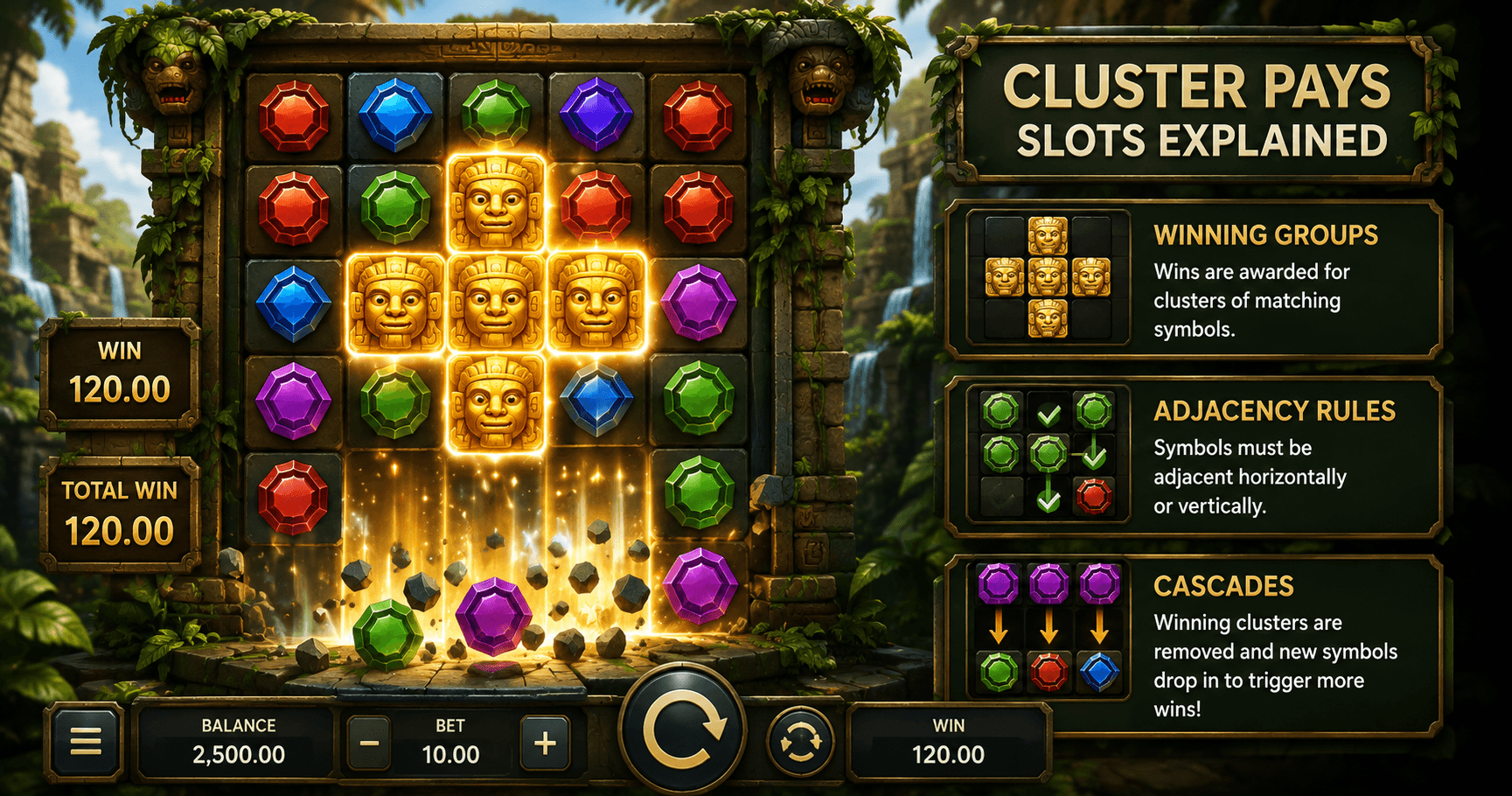
A cluster pays slot does not ask matching symbols to follow one fixed line from left to right. It looks for a connected group on a grid. The size of that group, the symbols allowed to join it and the directions that count as connected are all set by the individual game.
That sounds simple until a screen contains two groups of the same symbol, a wild touches several positions, or a winning group disappears and new symbols fall into the empty spaces. The paytable—not the shape that looks most obvious on screen—decides how each case is counted.
This guide explains the usual cluster-pays sequence, including adjacency, minimum group size, overlapping shapes, cascades and feature interactions. For a comparison with other win systems, read Paylines vs Ways to Win in Online Slots. Current slot types and provider information are listed on the Play88 Online Slots Malaysia page.
Rules, grid sizes, values and features vary by title. Review the in-game paytable before a paid spin, set spending and time limits, and do not treat any layout as a guaranteed result.
What Does Cluster Pays Mean?
Cluster pays is a win system in which matching symbols must form a connected group. Many titles use a square grid rather than conventional reels, although the visual layout alone does not determine the rule. Some cluster games require five matching symbols; others set another minimum or use different thresholds for different symbols.
| Element | General purpose | What to check |
|---|---|---|
| Grid | Holds the symbols used to form connected groups. | Grid dimensions and whether the size can change |
| Qualifying symbol | A regular symbol eligible to form a cluster award. | Its minimum count and value table |
| Adjacency rule | Defines which neighbouring positions count as connected. | Horizontal, vertical and any stated diagonal connection |
| Wild | May substitute for qualifying symbols under stated restrictions. | Excluded symbols and multiplier behaviour |
| Cascade or tumble | Removes selected symbols and supplies replacements. | Which symbols disappear and when the sequence ends |
| Cluster paytable | Shows the award for each symbol and qualifying group size. | Whether values are coins, stake multiples or currency amounts |
A large block of symbols is not automatically a win. It must contain an eligible symbol, meet the stated minimum and follow the connection rule. Scatters, bonus icons, collectors and other special symbols may occupy the grid without counting as ordinary cluster symbols.
How Do Adjacency Rules Work?
Most cluster-pays rules connect symbols that touch along an edge: left, right, above or below. Two symbols that meet only at a corner are diagonal neighbours and usually do not connect unless the paytable expressly includes diagonals.
| Position relationship | Common treatment | Reason to verify |
|---|---|---|
| Side by side | Commonly connected | The symbols share a horizontal edge. |
| One above another | Commonly connected | The symbols share a vertical edge. |
| Touching at one corner | Commonly not connected | Diagonal links count only when the rules say so. |
| Separated by a wild | May connect through the wild | The wild must be allowed to substitute for that symbol. |
| Separated by an empty or special position | Commonly separate groups | Non-substituting positions interrupt the connection. |
A cluster can bend around corners and form an irregular shape. It does not need to be a rectangle. Starting from one matching symbol, follow only the permitted neighbour directions; every matching position reachable through that chain belongs to the same connected group.
How Does Cluster Size Affect a Win?
The paytable normally lists value bands. A group of five to seven symbols may use one value, eight to ten another, and a larger cluster a higher one. The exact bands differ by game and symbol.
Suppose an illustrative paytable lists these values for one symbol:
| Connected symbols | Illustrative award | Settlement point |
|---|---|---|
| 1–4 | No cluster award | The minimum size has not been reached. |
| 5–7 | 0.5x the applicable stake unit | All connected symbols form one qualifying group. |
| 8–10 | 1.5x the applicable stake unit | The group uses the band containing its final size. |
| 11 or more | 4x the applicable stake unit | The top listed band applies unless another cap is stated. |
These numbers are examples, not Play88 game values. A title may pay by total stake, line stake, coin value or another defined unit. Read the label beside the paytable and check whether the displayed amount already reflects the selected bet.
How Are Separate and Overlapping Groups Counted?
Two groups of the same symbol can appear on one grid without connecting. If each meets the minimum, they may be settled as two clusters. If only one qualifies, only that group produces the stated award.
A wild can make the picture less obvious. One wild may touch matching symbols on several sides and join them into a single larger cluster. In another title, the same wild may be assigned to one winning group or evaluated separately. The game’s calculation rules decide whether a shared symbol contributes to more than one award.
| Grid situation | Possible settlement | Rule to inspect |
|---|---|---|
| Two matching groups with a gap | Two separate clusters if both qualify | Minimum size for each group |
| Two groups connected by one matching symbol | One larger cluster | Edge-adjacency rule |
| Two groups connected by a wild | One group or title-specific evaluation | Wild substitution and shared-symbol rules |
| Matching symbols touching only diagonally | Usually separate | Whether diagonal adjacency is permitted |
| One group touches a scatter | The scatter commonly remains a separate feature symbol. | Whether that scatter can substitute or be removed |
Do not add every matching symbol on the screen together. Count connected positions according to the game rules, then apply the band shown for that group.
What Happens During a Cluster Cascade?
Many cluster titles remove winning symbols after settlement. Symbols above drop into the empty positions, and new symbols enter the grid. The resulting layout is checked again without charging a new base stake unless the rules describe a different paid action.
- The original grid stops.
- Every qualifying cluster is identified and valued.
- The symbols specified by the rules are removed.
- Remaining symbols move into the empty positions.
- New symbols arrive.
- The updated grid is checked for another qualifying cluster.
- The sequence ends when no new cluster forms or a stated limit is reached.
A cascade is part of the same paid spin in many titles, but feature terminology is not universal. A “tumble,” “avalanche,” “reaction” or “drop” may use a similar sequence with different multiplier, meter or removal rules. The earlier Slot Autoplay and Turbo Mode guide explains why animation speed does not change the accepted stake or the underlying result rules.
Multipliers During Cascades
A multiplier may reset on every base spin, rise after each consecutive cluster or persist throughout a bonus. If several multipliers apply, the title may add them, multiply them or apply only a selected value. Never infer the calculation from the visual size of the multiplier badge.
How Do Other Features Interact With Cluster Pays?
| Feature | Possible role | What to confirm |
|---|---|---|
| Wild symbol | Substitutes for a paying symbol or carries a multiplier. | Eligible symbols and how multiple wilds combine |
| Mystery symbol | Reveals or transforms into another symbol before clusters are evaluated. | Reveal order and eligible outcomes |
| Collect symbol | Collects displayed values or advances a meter. | Which positions it reads and when collection occurs |
| Free spins | Provides a stated number of feature spins with altered rules. | Retriggers, persistent modifiers and feature-end conditions |
| Expanding grid | Adds positions or changes the available cluster space. | Trigger, maximum grid size and reset point |
| Symbol meter | Tracks qualifying symbols removed or collected. | Thresholds, rewards and whether progress persists |
The sequence matters. A mystery reveal can happen before cluster detection, while a collector may act after a win or at the end of a cascade chain. If the order is unclear, use the game’s Help screen rather than trying to reconstruct it from the animation.
How Is a Cluster Award Calculated?
A general illustration is:
Cluster award = applicable stake unit × paytable value for the symbol and cluster size × applicable multiplier
Assume a title uses the total spin stake as its unit. A 10-symbol cluster is listed at 1.5x, and a 2x multiplier applies. With an illustrative MYR 1 stake:
MYR 1 × 1.5 × 2 = MYR 3 gross award
If a second cluster forms in the same cascade, it is valued under the rules for that new grid. Do not assume the first group’s size, symbol or multiplier carries forward. Gross award and profit are also different terms: the interface may describe the total credited amount, while profit accounts for the paid stake.
How Do RTP, Volatility and Maximum Win Apply?
Cluster pays describes how a winning group is formed. It does not by itself state the game’s RTP, volatility or maximum win.
- RTP is a long-term theoretical percentage under the stated configuration, not a return promised for one session.
- Volatility describes the intended distribution of award frequency and size; two cluster games can have different profiles.
- Maximum win is the highest award or multiplier recognised under the title’s stated rules and caps.
- Hit frequency, where published, is not the same as the probability of finishing a session ahead.
Review the individual title rather than treating “cluster pays” as a mathematical category with one shared value. The Slot Volatility guide explains how low, medium and high labels should be read.
What Should You Check Before Playing a Cluster-Pays Slot?
| Item | Question to answer |
|---|---|
| Minimum cluster | How many connected symbols are required? |
| Adjacency | Do horizontal and vertical links count, and are diagonals excluded? |
| Paytable unit | Are awards shown as coins, stake multiples or currency amounts? |
| Wild rules | Which symbols can wilds replace, and can they join groups? |
| Cascade | Which symbols disappear, and when does the sequence stop? |
| Multipliers | Do they reset, increase, add together or multiply? |
| Feature state | Which meters or modifiers persist between cascades or spins? |
| Game information | What RTP, volatility, stake range and maximum-win rule apply? |
| Personal limits | What spending and time limits were set before the session? |
Common Cluster-Pays Reading Mistakes
Counting Diagonal Symbols Without Checking
Symbols that touch only at a corner often belong to separate groups. Diagonal connections count only when the rules explicitly allow them.
Adding Every Matching Symbol on the Grid
Matching symbols separated by gaps form separate groups. Each group must independently meet the minimum unless a permitted wild or another rule connects them.
Assuming Every Cluster Game Uses Five Symbols
Five is common, not universal. The minimum and award bands belong to the individual title.
Assuming Every Cascade Increases a Multiplier
Some titles increase a multiplier, some keep it fixed and others use no cascade multiplier. Check its reset and combination rules.
Treating a Long Cascade as Evidence About the Next Spin
A completed sequence does not make another sequence due. For random-number-based slots, previous outcomes do not provide a reliable prediction of the next result.
Chasing a Nearly Full Meter
A meter can reset when the feature, spin or session ends. Even persistent progress does not guarantee the next paid spin will complete it.
Related Slot Mechanics Guides
These companion guides examine features that can appear inside a cluster-pays title or affect how its final award is read:
- Sticky, Expanding and Walking Wilds in Slots explains substitution, movement and persistence.
- Collect Symbols and Prize Meters in Slots explains value collection, thresholds and resets.
- Maximum Win in Online Slots separates multiplier limits, currency caps and jackpot rules.
Practical Safer-Play Guidelines
- Set a fixed spending limit and time limit before opening the game.
- Use only money not required for essential expenses.
- Check the total stake before every paid spin.
- Do not treat a larger grid or nearly formed cluster as a reason to continue.
- Do not increase the stake to recover earlier losses.
- Keep autoplay stop conditions conservative if the title offers autoplay.
- Use deposit limits, cooling-off periods or self-exclusion when needed.
End the session if either limit becomes difficult to maintain. The Play88 FAQ provides general account, support and responsible-gaming information.
Frequently Asked Questions About Cluster Pays Slots
What is a cluster pays slot?
A cluster pays slot awards connected groups of matching symbols according to its paytable instead of requiring every win to follow a fixed payline. The minimum group size and connection rules vary by title.
Do diagonal symbols count in a cluster?
Commonly no. Many cluster games count symbols that share a horizontal or vertical edge, while corner-to-corner connections are excluded unless the rules specifically include diagonals.
Can one grid contain more than one winning cluster?
Yes. Separate groups can each qualify if they meet the minimum size. A wild or matching bridge may instead connect them into one larger group under the title’s rules.
Is a cascade a new paid spin?
Commonly a cascade continues from the same accepted spin without another base stake, but the game’s rules determine the sequence and any separate paid actions.
Does every cascade increase a multiplier?
No. Multiplier behaviour varies. It may rise, remain fixed, reset after the sequence or not apply at all.
Are cluster pays slots always high volatility?
No. Cluster pays describes the win pattern, not one fixed volatility level. Check the RTP, volatility and paytable for the individual game.
Read the Grid by Rule, Not by Shape
The reliable way to read a cluster-pays result is to start with the adjacency rule, identify each connected group, check its final size and then apply any wild, multiplier or cascade condition in the stated order. A shape that looks close to a win has no separate value unless the paytable gives it one.
Find current games and provider information on the Play88 Online Slots Malaysia page. Titles, features, values, configurations and availability may vary by provider, account and location.
This article provides general information and does not guarantee any result. Participate only where permitted by applicable law, meet all applicable age requirements and play responsibly.