
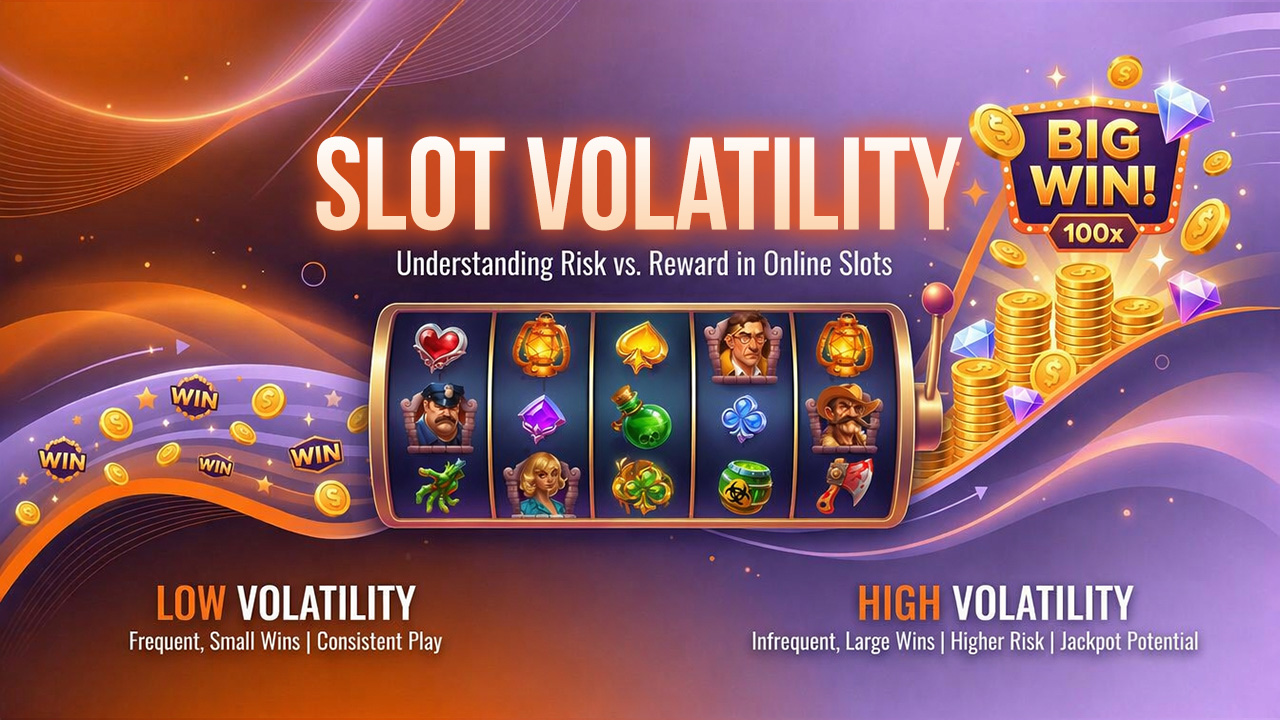
Two online slots can have a similar theme and the same published RTP while producing very different playing experiences. One may return smaller prizes more often, while another may go through longer periods without a notable payout before producing a larger result. Slot volatility is the term used to describe this difference.
Understanding volatility can help players compare games more accurately. It does not predict a win, identify a profitable slot or remove the risk of loss. It simply explains how a game’s payouts may be distributed over time.
When reviewing Play88 online slots, check volatility together with RTP, the paytable, stake range and feature rules. Each measurement answers a different question about the game.
What Is Slot Volatility?
Slot volatility, sometimes called slot variance, describes the expected variation in the size and frequency of a game’s payouts. Providers commonly use labels such as low, medium or high, although the exact definition can differ between providers.
A low volatility slot generally places more of its theoretical return into smaller, more frequent payouts. A high volatility slot generally places more of its return into larger, less frequent payouts. Medium volatility sits between these two patterns.
These descriptions apply to a game’s mathematical design over a large amount of play. They do not tell a player what will happen during the next spin or a short session.
Low, Medium and High Volatility Slots Compared
| Volatility level | General payout pattern | Possible session experience | Important point |
|---|---|---|---|
| Low | Smaller payouts may occur more frequently | The balance may change in smaller amounts | Frequent payouts can still be lower than the amount wagered |
| Medium | A mixture of smaller and larger payouts | Results may vary more than in a low volatility game | The label does not guarantee a balanced result in one session |
| High | Larger payouts may occur less frequently | Longer periods without a meaningful payout may occur | A larger potential payout comes with greater short-term variation |
This comparison is a general guide. A provider may calculate or describe volatility differently, so the information shown inside the exact game should take priority.
Low Volatility Slots
Low volatility slots are designed to distribute more of their theoretical return through smaller payouts that may occur more regularly. This does not mean every spin pays or that a session will last for a set period.
A payout is also not always a profit. If a spin costs MYR1 and returns MYR0.40, the game records a payout, but the balance has still fallen by MYR0.60. This is why payout frequency should not be confused with the chance of finishing ahead.
Low volatility may suit someone who prefers smaller changes in balance, but the full stake can still be lost. Review the minimum stake, maximum stake and feature costs before starting.
Medium Volatility Slots
Medium volatility slots generally combine elements of low and high volatility designs. They may offer a mixture of smaller regular payouts and less frequent larger prizes.
The word medium is not a universal mathematical rating. One provider’s medium volatility game may behave differently from another provider’s game with the same label. The paytable and official game information provide more useful context than the label alone.
High Volatility Slots
High volatility slots generally concentrate more of their theoretical return in larger payouts that occur less often. A player may therefore see wider balance changes and longer stretches without a significant return.
High volatility does not mean a large payout is waiting after a series of losses. In a conventional random number generator slot, previous independent results do not make the next result due. Continuing to play or increasing the stake cannot force a bonus or recover earlier losses.
A high maximum win can attract attention, but it does not show how likely that result is. Check the maximum payout rules, qualifying stake and feature conditions before participating.
Slot Volatility vs RTP
RTP and volatility describe different parts of a slot’s design.
| Measurement | What it describes | What it cannot predict |
|---|---|---|
| RTP | The theoretical percentage of total wagers returned as payouts over extensive play | The result of one player, spin or session |
| Volatility | How payout sizes and frequencies may vary | When the next payout will occur or how large it will be |
Consider two hypothetical games with a theoretical RTP of 96 percent. The first is low volatility and may distribute more of its return through smaller payouts. The second is high volatility and may distribute more of its return through less frequent, larger payouts. Their theoretical RTP is the same, but their payout patterns differ.
The UK Gambling Commission’s guidance on RTP monitoring notes that game volatility affects how widely actual results may vary from theoretical RTP when only a limited amount of play is measured.
For a detailed explanation of theoretical and actual return, read what RTP means in slot games.
Slot Volatility vs Hit Frequency
Hit frequency describes how often a spin produces a qualifying payout under the game’s rules. Volatility describes how payout values may be distributed. These measurements are related, but they are not interchangeable.
A game can have a relatively high hit frequency because it produces many small payouts. Some of those payouts may be lower than the stake. Another game may have a lower hit frequency but place more value in larger awards.
Neither measurement reveals whether a player will make a profit. They are descriptive statistics, not predictions.
How to Find a Slot’s Volatility
Providers may display volatility in one of several locations:
- The paytable
- The game information screen
- The help or rules section
- The provider’s official game page
- A game facts panel
Look for terms such as volatility, variance, low, medium or high. Some providers use a rating scale or a row of indicators instead of words.
If no volatility rating is published, do not assume that a short demo session can reveal it. A small number of spins is not enough to measure a game’s long-term payout distribution reliably.
Do Bonus Features Change Volatility?
Features can affect how a game feels during play. Free spins, multipliers, cascading reels, respins and jackpots may place part of the game’s theoretical return into events that occur less frequently than ordinary base-game payouts.
Some games also offer optional feature purchases or separate playing modes. These may use different stake amounts, RTP settings or payout distributions. Check the rules for the selected mode rather than assuming the base-game information applies to every option.
A feature that appears close to triggering is not evidence that it will occur soon. Unless the rules describe a persistent meter or saved state, visible near-misses should not be used to predict the next result.
How to Review Volatility Before Playing
When checking a slot at Play88, use the following process:
- Open the paytable. Confirm how winning combinations, wilds, scatters and bonus features work.
- Check the volatility label. Use the provider’s description and remember that ratings are not standardised across all games.
- Check the exact RTP. Different versions of the same title may use different RTP settings.
- Confirm the total stake. Review the minimum, maximum and total cost of one paid round.
- Read the feature conditions. Check trigger rules, additional costs, qualifying stakes and maximum payout limits.
- Set limits before starting. Decide on a fixed entertainment amount and a time limit.
If the terminology is unfamiliar, the Play88 online slots guide for beginners explains reels, paylines, ways to win, paytables and common bonus features.
Common Slot Volatility Myths
| Claim | What to understand |
|---|---|
| A low volatility slot cannot lose quickly | Any slot can produce a losing sequence, and the full amount allocated to a session can be lost |
| A high volatility slot must pay after many losses | Previous independent spins do not make a future payout due |
| High volatility means high RTP | Volatility and RTP measure different parts of the game |
| Medium volatility guarantees balanced results | A short session can still vary widely from the game’s long-term design |
| Frequent payouts mean frequent profits | A payout can be smaller than the amount wagered |
Safer Play and Spending Limits
Volatility can help describe risk, but no volatility level makes slot play safe or profitable. Use only money set aside for entertainment and assume that the full amount may be lost.
- Set a spending limit and time limit before opening a game.
- Do not borrow money or use funds needed for bills and essential expenses.
- Do not increase the stake to recover a previous loss.
- Take a break if play stops feeling controlled or enjoyable.
- Use available deposit limits, time-outs or self-exclusion tools when needed.
GamCare provides additional safer gambling information. Play88 account and support information is also available in the Play88 FAQ.
Frequently Asked Questions
What does volatility mean in online slots?
Volatility describes how a slot’s payouts may vary in size and frequency. Low volatility generally means smaller, more frequent payouts, while high volatility generally means larger, less frequent payouts.
Are low volatility slots better than high volatility slots?
No volatility level is automatically better. The labels describe different payout patterns. Every slot carries a risk of loss, and neither low nor high volatility can guarantee a winning result.
Is slot volatility the same as RTP?
No. RTP describes the game’s theoretical long-term return percentage. Volatility describes how payouts may be distributed. Two games can have the same RTP and different volatility levels.
Can I determine volatility by watching recent spins?
No. A short sequence of spins is not a reliable measure of a game’s long-term mathematical design. Check the paytable, game information or official provider documentation.
Does high volatility mean a slot is due to pay?
No. High volatility can involve longer periods without a significant payout, but it does not create a schedule for wins. Previous independent outcomes do not make the next payout due.
Final Points to Remember
Slot volatility explains the general pattern of payout sizes and frequencies. Low volatility slots may return smaller amounts more often, while high volatility slots may produce wider swings and less frequent larger payouts. Medium volatility falls between these patterns, but provider definitions can vary.
Use volatility together with RTP, hit frequency, stake limits and the paytable when comparing games on Play88. None of these measurements can predict a session result. Set firm time and spending limits before playing and stop when either limit is reached.