Press Spin and the reels blur, slow down and stop one after another. It feels as though the game is making its decision while you watch. In most online slots, that is not what is happening. The animation reveals a result produced by software behind the scenes.
At the centre of that process is a random number generator, usually called an RNG. It supplies the numbers the game uses to select reel positions, symbols or feature events. The graphics then turn that selection into the result shown on the screen.
This matters because reel animations can tempt players to see patterns that are not there. A long losing run does not build up credit for a future win, and a bonus symbol landing just outside the payline is not a clue about the next spin. Understanding the RNG will not help anyone predict a result, but it does make the game easier to read without the usual myths.
In This Guide
- What a slot RNG actually does
- How random numbers become a reel result
- RNG, RTP and volatility compared
- Why previous spins do not predict the next one
- What technical testing looks for
- Common slot RNG myths
- Slot RNG questions answered
What a Slot RNG Actually Does
An RNG produces numbers that the slot software turns into an outcome. Depending on the game, those numbers may point to virtual reel positions, select symbols or control part of a bonus feature.
Many digital games use a pseudorandom number generator, or PRNG. It starts with an internal value known as a seed and uses an algorithm to create a stream of numbers. The word pseudo can sound suspicious, but it does not mean a player can spot the pattern. A properly built system is designed to make its next output impractical to predict without protected information such as the algorithm, seed and current internal state.
Think of the RNG as the source of the raw input, not the whole game. The slot still needs rules that map each number to a possible result, a paytable that sets the awards and software that settles the round correctly.
From Pressing Spin to Seeing the Result
Providers do not all build their games in exactly the same way. A typical software slot, however, follows this basic sequence:
- You confirm the stake and press Spin. The game records the cost of the round and the mode you selected.
- The game requests random numbers. It may need one value or several, depending on how the slot is built.
- Those numbers are matched to the game rules. Virtual reel strips, symbol weighting and active features determine what appears.
- The paytable is applied. The software checks paylines, ways or clusters and calculates any award.
- The screen reveals the outcome. The reels, sounds and animations present the result in a way that is easy to follow.
One round can involve several random selections. A cascade may need a fresh set of symbols, while a respin or mystery reveal may call for another random value later in the feature. The paytable should explain what the feature does, but it will not expose the provider’s source code or upcoming numbers.
Why the Reel Animation Can Be Misleading
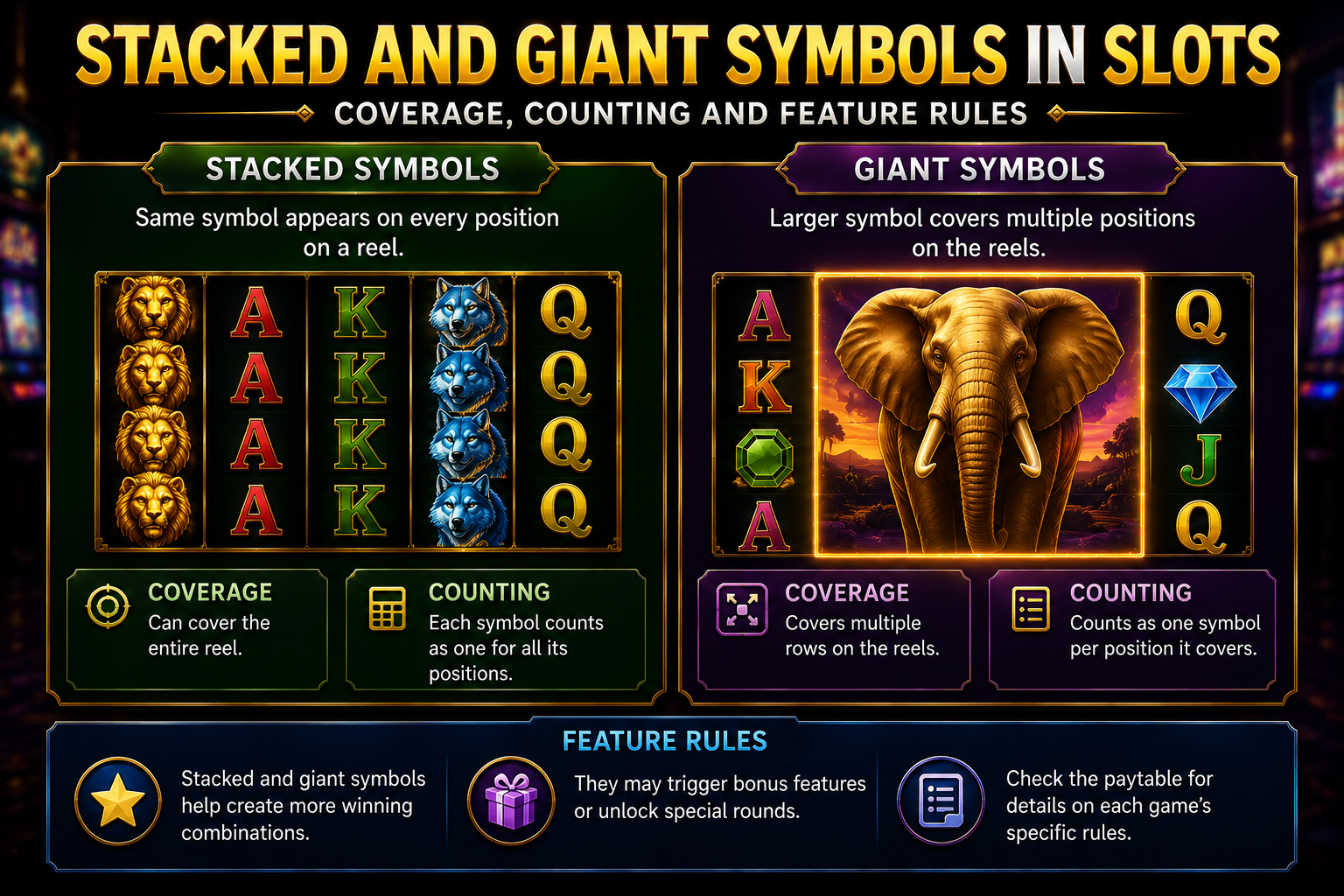
The reels on the screen are a visual presentation. They do not have to behave like the physical reels inside an old mechanical machine. A digital slot can use long virtual reel strips, and one symbol may occupy more positions than another.
For that reason, counting the symbols seen during a handful of spins will not reveal the true chance of landing a combination. The visible sample is tiny, and it does not show the full reel mapping behind the game.
The same applies to dramatic pauses. Two bonus symbols may land before the final reel slows down, but the suspense does not make a third symbol more likely on the following spin. It is presentation, not a forecast.
RNG vs RTP, Volatility and Hit Frequency
These four terms are often mixed together, even though each answers a different question about the game.
| Term | What it describes | What it does not tell you |
|---|---|---|
| RNG | Produces random inputs used to determine game outcomes | Whether the next spin will win |
| RTP | Theoretical percentage of total stakes returned as awards over extensive play | The result of one player or short session |
| Volatility | How payout sizes and frequencies may vary | When a larger award will occur |
| Hit frequency | How often a qualifying payout is expected under the game’s model | Whether a payout will be greater than the stake |
The RNG supplies the numbers. The game’s maths decides what those numbers mean and how much each result pays. Random does not mean every symbol must have the same chance of appearing. A low-value symbol can occupy more virtual reel positions than a high-value one while the selection process remains random.
For more detail on long-term theoretical return, read what RTP means in slot games. The separate guide to slot volatility explains why games with similar RTP figures can produce different payout patterns.
Why the Last Spin Does Not Control the Next One
In a standard random slot, one spin does not create a debt that the next spin has to repay. Five losing rounds do not make the sixth more likely to win. A large win does not force the game into a cooling-off period either.
A spin history can be useful for checking what you spent and received. It cannot show that a game is becoming hot or cold because it contains no information about the next random number.
There is one important distinction. Some games have a meter, collected item, free-spin counter or jackpot value that carries forward under clearly stated rules. That saved state can change which feature rules are active, but it does not turn past random results into a prediction. Check when the feature resets and whether it belongs to one player, one session or the game as a whole.
Can a Slot Change the Odds for One Player?
A properly implemented random game should not make a result more or less likely because one player recently deposited, withdrew, won or lost. Some regulatory standards expressly ban this kind of adaptive or compensated behaviour.
The account system can still control matters around the game, including eligibility, stake limits, bonus balances, location restrictions and responsible-gaming tools. Those controls are separate from the software that selects the result.
That said, an RNG badge is not proof by itself. The useful checks are the provider’s identity, accessible game rules and relevant licensing or testing information.
Bet Size, Autoplay and Turbo Mode
Increasing the stake normally changes the amount at risk and the value of a payout; it does not make a win due. There are exceptions in the rules, not in the concept of randomness. A jackpot, optional feature or separate mode may require a qualifying stake and may carry a different RTP. Always check the paytable for the version and mode being used.
Autoplay simply requests a series of spins, while turbo or quick-spin mode shortens the animation. With the same game settings, neither changes the underlying odds. What they can change is the pace of spending, because more rounds fit into the same amount of time. See how slot autoplay and turbo mode work for spin counts, stop conditions and cost checks.
What Technical RNG Testing Looks For
Testing an RNG is not as simple as pressing Spin a few thousand times and checking whether the wins look evenly spaced. Technical reviews may examine the generator itself and the full path from a random number to the result credited to the account. That distinction matters: the number generator can work correctly while a fault elsewhere in the game still maps or pays a result incorrectly.
Testing and review may cover:
- Distribution: whether RNG output and game outcomes follow the expected theoretical probabilities over an appropriate test sample.
- Unpredictability: whether the next value is impractical to predict without protected internal information.
- Seeding and reseeding: whether the method avoids repeated or synchronised output streams and does not introduce a predictable pattern.
- Scaling: whether converting a large RNG range into the values required by the game introduces unintended bias.
- Outcome mapping: whether random inputs are mapped to virtual reels, symbols and features according to the intended mathematical model.
- Rules and paytables: whether the game evaluates and pays results as described to the player.
- Error handling: whether faults are logged and affected rounds are handled according to published rules.
For example, the UK Gambling Commission’s standard for generating random outcomes covers distribution, unpredictability, seeding, scaling, outcome mapping and adaptive behaviour. Other jurisdictions may use different standards and approval processes, so this example should not be treated as a universal checklist.
Why a Personal Spin Log Cannot Prove an RNG Is Fair
A personal spin log shows exactly one thing: what happened in that sample. It cannot reliably prove that an RNG is fair or unfair. Random sequences naturally contain streaks, repeated symbols and uneven patches. Even a large record may be missing the virtual reel mapping, feature states and theoretical probabilities needed to interpret it correctly.
Formal testing requires suitable statistical methods, technical access and a defined mathematical model. A balance history is still valuable, but mainly as a spending record—not as a tool for reverse-engineering the next spin.
If a result appears inconsistent with the paytable, handle it as a specific settlement issue. Save the round ID, time, stake and screenshots, compare them with the rules and contact support. That is evidence worth checking. An ordinary losing sequence, by itself, is not.
Near Misses Feel Important, but They Are Still Losses
A near miss is a losing result that looks close to something more valuable—for example, two bonus symbols landing while a third stops just outside the required position. It catches the eye, but it does not improve the chance of that symbol appearing on the next spin.
The display should also reflect the result that was actually selected, rather than swapping an ordinary loss for a more dramatic-looking one. The UK Gambling Commission’s random-outcome standard, for example, prohibits false near-miss substitutions.
The practical takeaway is simple: settle the round according to the paytable, then treat the next standard spin as a new random event.
Common Slot RNG Myths
| Claim | What to understand |
|---|---|
| A slot must pay after a long losing sequence | Previous standard spins do not make a future random outcome due |
| A recent jackpot means the game is now cold | A previous jackpot result does not reveal the next RNG output |
| Turbo mode reduces the chance of winning | Turbo mode changes presentation speed, although faster play can increase spending speed |
| A near miss means a bonus is getting closer | A near miss is a completed losing result, not a forecast |
| Changing the spin time can control the result | Button timing does not provide the protected RNG state needed to predict an outcome |
| Random means every symbol has equal odds | Symbols and outcomes can have different probabilities defined by the game model |
How to Review an Online Slot Before Playing
Recent results are the least useful place to look for information about the next spin. Check the parts of the game you can actually verify:
- Open the rules and paytable. Confirm how wins form, how features trigger and how awards are calculated.
- Check the exact RTP. Different versions or playing modes can have different theoretical returns.
- Review volatility and maximum win. These provide context about payout variation and the award cap, not a prediction.
- Confirm the total stake. Include optional bets, feature purchases and the cost of any automated sequence.
- Identify persistent features. Check when meters, collected values or counters carry forward and reset.
- Check who made the game. Look for clear rules and relevant licensing or testing details instead of relying on badges or visual claims.
- Set limits before starting. Decide the maximum entertainment spend and session length in advance.
If the basic terms are unfamiliar, begin with the Play88 online slots guide for beginners.
Practical Safer-Play Guidelines
Randomness does not create a system for recovering losses. If a session budget cannot be comfortably lost in full, it is too high.
- Set a fixed spending limit and time limit before opening a game.
- Do not increase the stake because a win feels due.
- Do not borrow money or use funds required for bills and essential expenses.
- Avoid using autoplay when it makes the cost or number of rounds harder to track.
- Take a break when play stops feeling controlled or enjoyable.
- Use available deposit limits, time-outs or self-exclusion tools when needed.
Additional support and safer-gambling information are available from GamCare.
Slot RNG Questions Answered
What does RNG mean in online slots?
RNG means random number generator. It produces numbers that the slot software maps to reel positions, symbols or feature events according to the game’s rules.
Is an online slot result decided before the reels stop?
Usually, yes. The game obtains the random input and selects the outcome before the reel animation finishes. A bonus feature may request more random values as the round continues, depending on how it is designed.
Can previous spins predict the next RNG result?
No. The history contains completed results, not the protected internal information needed to calculate the next number. Streaks can happen naturally without forming a predictable cycle.
Does the RNG change when the stake changes?
The RNG still supplies random input, but another stake, optional bet or game mode may use different payout values or eligibility rules. Check the exact paytable before confirming the round.
Are RTP and RNG the same thing?
No. The RNG supplies the random inputs. RTP is the game’s theoretical long-term return percentage. Neither tells a player what one spin or one session will produce.
Does a near miss mean a slot bonus will trigger soon?
No. A near miss is a completed losing result. It does not make a bonus symbol or winning combination more likely on the next independent standard spin.
Can autoplay or turbo mode improve RNG results?
No. They automate rounds or shorten the animation; they do not improve the odds. Their real effect is speed, which can make spending build up more quickly.
Focus on the Rules, Not the Reel Drama
The RNG supplies the numbers, the game rules turn them into an outcome and the paytable sets any award. The reel animation makes that process visible, but it offers no preview of what comes next.
RTP, volatility and hit frequency can help explain how a slot is designed, but none of them predicts the next spin. Read the rules, confirm the stake and feature conditions, and set limits before playing. Losing streaks, recent wins and near misses may feel meaningful; mathematically, they do not make the next result due.