
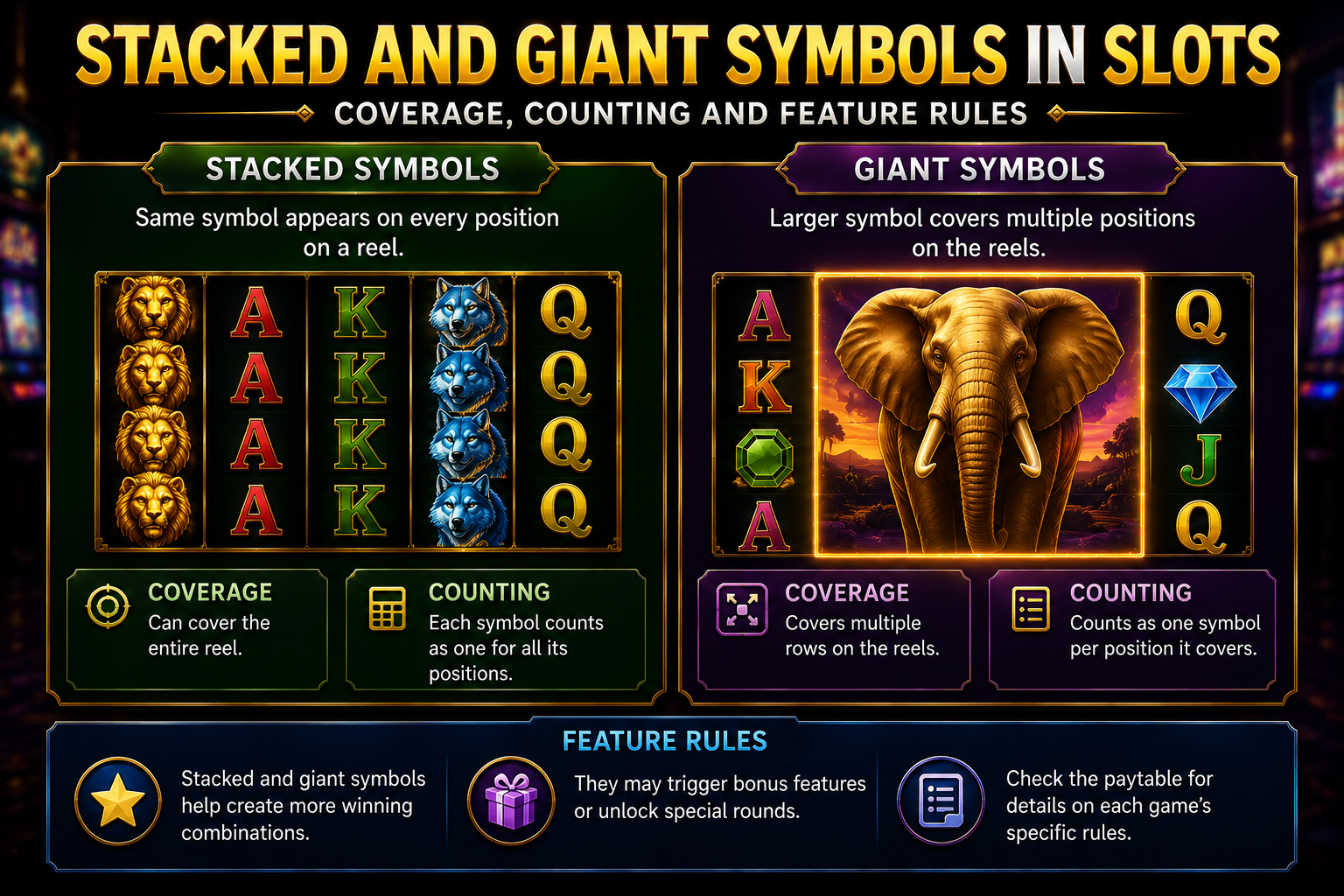
A stack and a giant symbol can look similar because both cover several reel positions. They are not necessarily counted the same way. A stack is commonly a run of repeated individual symbols, while a giant or colossal symbol can be one oversized object spanning several cells.
That distinction affects paylines, ways, clusters, wild substitution and multiplier handling. A three-position stack may contribute three matching positions to separate combinations. One 2×2 giant symbol may count once, once per covered row, or as several represented positions, depending on the title.
This Play88 guide explains the main formats and a practical way to check them. Current categories and provider information are available through the Play88 Online Slots Malaysia page. Symbol behaviour, stake ranges and availability vary by game, provider, account and location.
What Are Stacked and Giant Symbols?
A stacked symbol appears in consecutive positions on a reel, commonly as repeated copies of the same icon. If three matching icons fill a reel vertically, each visible copy can remain an individual symbol position.
A giant symbol is drawn across a block such as 2×2, 3×3 or an entire reel. Providers may call it oversized, colossal, super-sized or mega. The graphic may represent one symbol with special counting rules rather than several ordinary copies.
| Format | Typical structure | First question to ask |
|---|---|---|
| Symbol stack | Repeated individual symbols in adjacent positions | Does each visible copy count separately? |
| Stacked wild | Several wild positions on the same reel | Which symbols can each wild substitute for? |
| Giant symbol | One graphic spanning a rectangular area | Is it treated as one symbol or represented positions? |
| Colossal wild | One oversized wild covering several cells | How often is any multiplier counted? |
| Full-reel symbol | A uniform icon or one block covering a reel | Is it a stack, expansion or single large symbol? |
The names are not perfectly standard across providers. The written help screen and paytable illustration should determine how a title uses each term.
What Oversized Symbol Formats Can Appear?
| Format | Possible behaviour | Detail to verify |
|---|---|---|
| Natural stack | A repeated run is built into a reel strip. | Whether the full stack must be visible |
| Added stack | A modifier places extra matching symbols on a reel. | Which reels and symbol ranks are eligible |
| Expanding stack | One symbol extends to cover more of its reel. | Whether expansion happens before win evaluation |
| Fixed giant block | A large symbol lands at a predefined size. | How it maps to the underlying cells |
| Variable giant block | The height or width changes by result. | Minimum, maximum and placement restrictions |
| Split symbol | One large graphic divides into ordinary symbols. | Whether the split creates new ways or only an animation |
A giant symbol can also appear only during free spins or after a special modifier. Its base-game absence does not mean the feature illustration is decorative; check the mode-specific paytable.
How Do Stacked Symbols Work?
Stacks increase the number of matching visible positions when the relevant part of a reel strip lands. On a five-reel, three-row slot, a full-height stack on reel two could place the same icon in all three rows. Each row may join a different payline or combine with matches on adjacent reels in a ways game.
A partial stack occurs when only part of the repeated run is visible. If two copies appear at the lower edge and the third sits outside the window, normally only the two active positions count. A provider may use an expansion rule that brings the rest into view, but that must be stated.
| Characteristic | Possible options | Why it matters |
|---|---|---|
| Stack length | Partial reel, full reel or variable height | Controls the number of visible matching positions |
| Eligible symbols | One premium icon, several ranks or wilds | Determines which combinations can benefit |
| Eligible reels | All reels or a restricted middle set | Affects where a stack can contribute |
| Natural or added | Part of the reel strip or placed by a modifier | Determines the activation sequence |
| Persistence | One spin, respins or full feature | Shows when stacked positions reset |
How Do Giant and Colossal Symbols Work?
A giant symbol occupies a defined block. A 2×2 block covers four grid cells, while a 3×3 block covers nine. Coverage does not by itself tell you how many matches it represents.
Possible counting methods include:
- one symbol for the entire oversized graphic;
- one represented symbol in every covered cell;
- one symbol on each covered reel or row;
- a title-specific contribution to each qualifying line or way;
- a special award separate from ordinary symbol combinations.
Placement can also be restricted. A 3×3 object cannot occupy a standard three-row window if it begins too close to an edge, unless the game clips, shifts or expands the grid. The placement rules may therefore reserve giant symbols for certain reels.
What Happens When Only Part of a Large Symbol Is Visible?
A stack can land partially because its repeated icons extend beyond the visible reel window. A giant symbol may also be clipped at the edge or revealed in stages. Only the active, recognised area should be counted under the paytable.
| Display | Possible treatment | Check before counting |
|---|---|---|
| Two icons from a three-symbol stack | Two ordinary positions count. | Whether a full stack is required for a modifier |
| Edge of an oversized graphic | It may be a decorative preview or a valid clipped block. | Whether the game marks active covered cells |
| Partially unlocked giant symbol | More of it may appear after grid expansion. | Whether earlier cells are re-evaluated |
| Split animation | The block may become several symbols. | At which stage wins are calculated |
| Expanding wild segment | A landed section may cover its full reel. | Substitution and multiplier rules after expansion |
How Are Large Symbols Counted on Paylines, Ways and Clusters?
Paylines
Each active line is evaluated through its defined positions. A stack can place a matching copy on several different lines. A giant symbol may contribute to every qualifying line that passes through its covered area, but the paytable controls whether the block is counted once or by position.
Ways to Win
In an adjacent-reel ways system, several matching positions on one reel can create several combinations. A three-position stack can therefore affect the ways count differently from one giant symbol that counts once on that reel. Review the Paylines vs Ways to Win guide for the base calculation.
Cluster Pays
A large graphic may occupy several adjacent cells and connect to surrounding matches. Some cluster games treat each covered cell as part of the cluster; others use one special block. Confirm the minimum group size and adjacency directions in the Cluster Pays guide.
| System | Stacked symbols may contribute | Giant symbol question |
|---|---|---|
| Fixed paylines | One copy to each line crossing the stack | Does each line through the block qualify? |
| Ways to win | Several matching positions on one reel | Does the block represent one or several positions? |
| Cluster pays | Several adjacent cells in a connected group | How many covered cells join the cluster? |
| Scatter pays | Each visible scatter may count | Can a giant special symbol count more than once? |
| Collect feature | Each value may be collected separately | Is the block one value or a group of values? |
How Do Stacked Wilds and Giant Wilds Behave?
A stacked wild commonly places several wild positions on one reel. Each wild substitutes under the normal rule, which may exclude scatters, bonus symbols, collectors or jackpots. A giant wild may cover several lines or ways at once, but it does not automatically substitute once for every cell.
Sticky, expanding and walking behaviours are separate properties. A stacked wild can disappear after evaluation, while a giant wild can remain for respins. The Sticky, Expanding and Walking Wilds guide explains those movement and persistence rules.
How Are Multipliers Applied to Large Symbols?
A multiplier can be printed on each wild in a stack or on one giant block. If the graphic covers six cells, the factor should not be applied six times unless the rules explicitly assign it to each represented position. Conversely, separate multiplier wilds in a stack may each contribute when the combination uses them.
| Situation | Possible rule | Needed detail |
|---|---|---|
| One 3× giant wild | Qualifying combination is tripled once. | Whether each crossed line is evaluated separately |
| Three 2× stacked wilds | Values may combine if several are used. | Additive, multiplicative or highest-only rule |
| Position multiplier under a giant symbol | Covered active cells may add local factors. | How many positions the block occupies for settlement |
| Global feature multiplier | Eligible wins may receive one overall factor. | Whether symbol multipliers also combine with it |
| Transforming oversized wild | Its factor may change after transformation. | Which value applies to the current evaluation |
The Slot Multipliers Explained guide covers scope, additive and multiplicative formulas, persistence and resets.
How Do Expansion, Reveals and Transformations Affect Large Symbols?
A full-reel symbol may begin as one landed icon and expand vertically. Another title may reveal a covered reel as a uniform stack. A third may transform several visible symbols into a giant block. These animations lead to similar final pictures through different sequences.
If the grid itself grows, a giant symbol may gain space to appear at a larger size. Determine whether the grid expands first and receives the block, or whether the block causes the expansion. The Expanding Reels and Growing Grids guide explains active-position timing.
Mystery symbols add another layer: a covered area may reveal as one giant icon or a stack of ordinary symbols. The current live guide to mystery symbols and transformations covers group reveals and evaluation order.
How Should a Stacked or Giant Symbol Result Be Checked?
- Confirm the stake, active mode and starting grid.
- Identify whether the graphic is a stack, one giant symbol or an expansion.
- Map every active position the symbol occupies.
- Apply the current payline, ways, cluster or scatter rule.
- Apply wild substitution and multiplier rules in order.
- Apply any cascade, transformation or grid change.
- Check the total against game history and the maximum-win rule.
Use the completed round record if the animation disconnects. A screenshot of a partly expanded block may not show the settled layout. Save the round reference when contacting support about a counting difference.
Stacked and Giant Symbol Checklist
| Item | Question |
|---|---|
| Format | Is the display a stack of copies, one oversized object or an expanding symbol? |
| Coverage | Which active reel or grid positions does it occupy? |
| Counting | Does it represent one symbol, each covered cell or another unit? |
| Win system | How does it contribute to paylines, ways, clusters or scatters? |
| Wild rule | Which symbols can it substitute for? |
| Multiplier | Is a printed factor applied once or through several positions? |
| Duration | Does the symbol stay for a respin or feature? |
| Personal limits | What time and spending limits apply to the session? |
Common Stacked and Giant Symbol Reading Mistakes
Treating a Giant Symbol as Several Copies Automatically
One large graphic may be one symbol for settlement even when it covers many cells.
Treating a Stack as One Oversized Symbol
Repeated icons can be independent positions that join several lines or ways.
Counting the Hidden Part of a Stack
Symbols outside the active window normally do not count unless an expansion rule brings them into play.
Applying a Giant Wild Multiplier Per Cell
A factor printed once on a block may apply once to each qualifying win, not once for every covered position.
Ignoring the Active Win System
The same stack creates different counting effects on fixed paylines, ways and cluster grids.
Assuming a Large Symbol Must Produce a Large Award
It still needs the required matching pattern and remains subject to the paytable and maximum-win conditions.
Related Advanced Slot Feature Guides
- Slot Multipliers Explained covers factors attached to stacked or giant wilds.
- Expanding Reels and Growing Grids in Slots explains how large symbols use changing layouts.
- Bonus Buy and Feature Buy in Slots covers paid entry into modes that may add oversized symbols.
- Choose-a-Bonus Features in Slots explains selections between symbol modifiers and other feature structures.
Practical Safer-Play Guidelines
- Set a session budget and time limit in advance.
- Read how the large symbol counts rather than judging only its screen area.
- Do not assume a partly visible stack makes the next result more likely.
- Keep the stake at or below the level chosen before play.
- Do not increase spending after a feature produces no award.
- Consider an account deposit limit, cooling-off period or self-exclusion if control becomes difficult.
Stop if maintaining a limit becomes difficult. The Play88 FAQ contains general account, support and responsible-gaming information.
Frequently Asked Questions About Stacked and Giant Symbols
What is a stacked symbol in a slot?
It is a run of repeated matching symbols in consecutive reel positions, commonly counted as individual visible positions.
What is a giant or colossal slot symbol?
It is one oversized graphic spanning several reel or grid cells, with counting rules defined by the title.
Does a 2×2 giant symbol always count as four symbols?
No. It may count once, by covered position or under another game-specific rule.
Can a stacked wild create several winning combinations?
It may contribute through several active positions, but the result depends on the payline, ways or cluster rules.
Does the hidden part of a symbol stack count?
Normally only visible active positions count, unless a stated expansion or reveal feature brings the remaining part into play.
Can a multiplier on a giant wild apply more than once?
Only if the rules say how the block and its covered positions contribute. A multiplier shown once should not automatically be repeated per cell.
Identify the Symbol Unit Before Calculating
First decide whether the display contains repeated copies or one large object. Then map its active positions and apply the title’s win system. That sequence is more reliable than counting the artwork by sight.
Current categories and provider details can be reviewed on the Play88 Online Slots Malaysia page. Symbol formats, paytables and availability vary by title.
This article provides general information and does not guarantee any result. Participate only where permitted by applicable law, meet all applicable age requirements and play responsibly.